
Mechanical vs Electrical Engineering 2026: Salary, Scope & Career Comparison
Job Description
1. Nature of Work & Job Scope
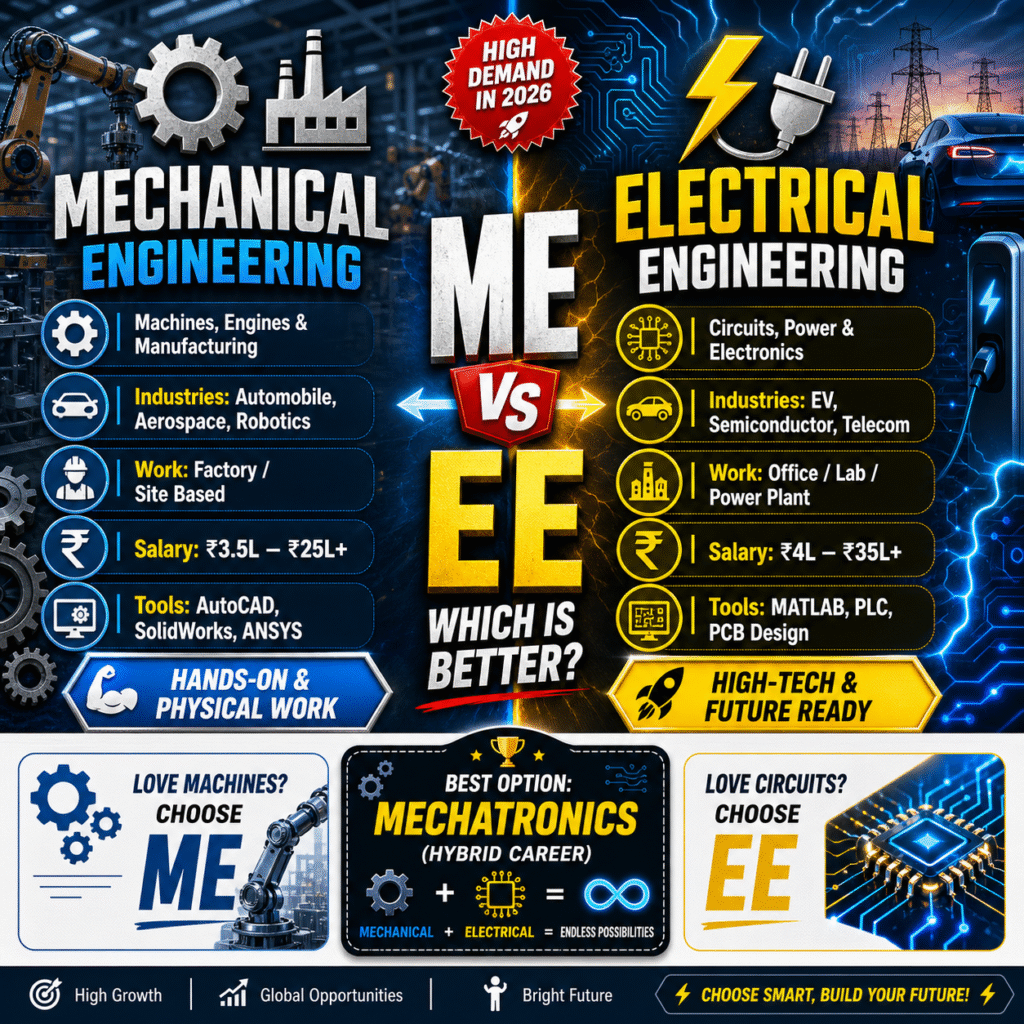
- Mechanical Engineering: This is the broadest engineering branch. You deal with anything that moves, from micro-scale sensors to massive spacecraft.
- Industries: Automobile, Aerospace, Manufacturing, HVAC, and Robotics.
- Work Environment: Often involves factory floors, production units, or onsite project management.
- Electrical Engineering: Focuses on electricity, electronics, and electromagnetism. With the rise of EV technology and automation, this field is expanding rapidly.
- Industries: Power Grids, Telecommunications, Semiconductors, Consumer Electronics, and Renewable Energy.
- Work Environment: Mostly office-based, labs, or power plants/substations.
2. Salary Structure (India & Global)
Generally, Electrical Engineers tend to have a slightly higher starting salary due to their proximity to the IT and semiconductor sectors.
| Feature | Mechanical Engineering | Electrical Engineering |
| Entry-Level (India) | ₹3.5L – ₹6L per annum | ₹4L – ₹7.5L per annum |
| Senior Level | ₹12L – ₹25L+ per annum | ₹15L – ₹35L+ per annum |
| Top Recruiters | Tata Motors, L&T, Mahindra, SAIL | BHEL, Power Grid, Intel, NVIDIA |
- Note: In cities like Bangalore or Pune, Electrical/Electronics engineers often command higher packages because they can easily pivot into VLSI or Embedded Systems roles.
3. Duty Hours & Work-Life Balance
- Mechanical: In manufacturing or site-based roles, duty hours can be long (10–12 hours), especially during project deadlines or machine breakdowns.
- Electrical: In R&D or maintenance roles, you typically find a standard 8-hour shift. However, power grid maintenance may require emergency “on-call” hours.
4. Other Key Factors (Bakimjinis)
- Tools & Software:
- Mechanical: Requires mastery of CAD (AutoCAD, SolidWorks, CATIA) and Simulation tools like ANSYS.
- Electrical: Requires knowledge of MATLAB, PLC/SCADA, and PCB design tools like Altium or Proteus.
- Future Trends:
- Mechanical is moving toward Industry 4.0 (Smart manufacturing and 3D printing).
- Electrical is driving the EV Revolution and Smart Grids.
- The “Hybrid” Path: If you like both, consider Mechatronics. It combines Mechanical, Electrical, and Computer Science, making you highly employable in Robotics and Automation.
Conclusion: Which One Should You Choose?
- Choose Mechanical if: You love machines, engines, and physical structures. If you are comfortable working in production plants and enjoy seeing physical products come to life.
- Choose Electrical if: You are fascinated by circuits, power distribution, or the inner workings of gadgets. If you prefer a job that often overlaps with high-tech software and semiconductor industries.
 Join Our WhatsApp Channel
 Join Our Telegram Channel
JOIN OUR IMPORTANT GROUPS
IT Jobs Update WhatsApp Group
Join NowKolkata Jobs WhatsApp Group
Join NowDiploma Jobs WhatsApp Group
Join NowITI Jobs WhatsApp Group
Join NowConnect With Us
WhatsApp ChannelTelegram Channel Instagram Page
 YouTube Channel
 Facebook Page
 WhatsApp
 LinkedIn